Did you start your orchestral playing in a youth orchestra?
So many of us had our first musical training in these amazing organisations, and we should be grateful to Ernest Read!
In 1926 he founded the London Junior Orchestra, one of the earliest earliest youth symphony orchestras which grew to have 11 affiliate youth orchestras throughout Great Britain and led to the founding of so many more!
And did you know that Ernest Read was a sprightly sixty-five when he started the first residential School Orchestra Course for children in 1944?
One attendee in the first two years was a young teacher named Ruth Railton – and she was inspired by the experience to start the National Youth Orchestra!
That’s what Sir Thomas Beecham called Dennis Brain, the British virtuoso horn player who was largely credited for popularizing the horn as a solo classical instrument with the post-war British public. He produced what many still consider to be the definitive recordings of Mozart’s horn concerti.
We’re proud to say that during the 1937/38 season Dennis was the third horn at ERSO. He joined age 16, introduced by older brother Leonard (an oboist) with the words “He’s been playing the horn for only a couple of years. He can do things as well as Dad can already!” As Dad was Aubrey Brain, Principal Horn at the BBC Symphony Orchestra, this was a sign of the great things to come!
Legendary clarinettist Jack Brymer inspired a generation to take up the instrument. But he didn’t plan to be a professional musician and initially trained and worked as a PE teacher.
His life was transformed when a report of his playing in ERSO reached Sir Thomas Beecham via Dennis Brain, another ERSO player, as Beecham was looking to fill the principal clarinet role at the RPO.
Brymer thought it was a friend playing a trick when he got the call! Of course he got the job and started to make clarinet history.
Well, you COULD learn the Strauss oboe concerto (though we hear its tricky).
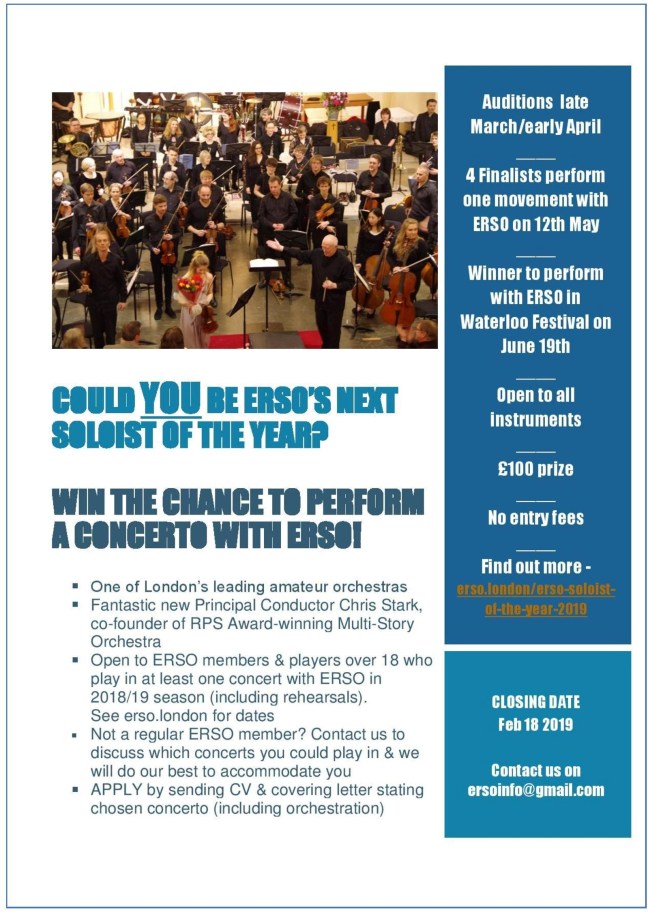
ORyou could enter our ERSO Soloist of the Year 2019 competition. Last year Michael was one of our four Finalists and they were all so amazing that they each have been given soloist opportunities with ERSO.
“So how do I do that?” we hear you say.
The competition is open to ERSO members or players who do at least one concert with us in the next season. Check it out and get in touch if you’re interested!
Well, you COULD learn the Strauss oboe concerto (though we hear its tricky).
ORyou could enter our ERSO Soloist of the Year 2019 competition. Last year Michael was one of our four Finalists and they were all so amazing that they each have been given soloist opportunities with ERSO.
“So how do I do that?” we hear you say.
The competition is open to ERSO members or players who do at least one concert with us in the next season. Check it out and get in touch if you’re interested!
But it so nearly wasn’t to be – and we’ve got his mum to thank!
Michael says: I started learning the oboe when I was 10 years old. I had previously been learning the recorder and initially wanted to move on to the flute, as I knew some children at my school who learned it. I suggested this to my mum who quickly responded with “no, everyone plays the flute- learn the oboe!”
The ERSO Talent programme was created to build on our long tradition of working with emerging professional musicians. It links all of our work with emerging professional soloists, conductors, orchestral musicians etc.
This year we have 2 great opportunities:
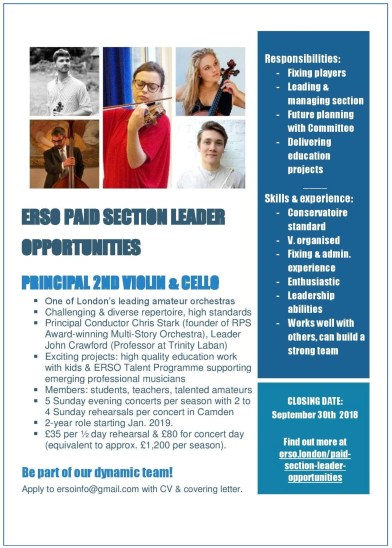
Paid Section LeaderOpportunities for a Principal 2nd Violin and Cello. These are 2 year roles that give the chance to lead and manage your section and play a part in setting the strategy for the orchestra.
ERSO Soloist of the Year 2019 – win the chance to perform your chosen concerto at the Waterloo Festival in June 2019.
Interested? Check out our website and get in touch on ersoinfo@gmail.com
Famous faces who gained experience at ERSO: Dennis Brain, Jack Brymer, Evelyn Rothwell and James Galway
When Ernest Read founded ERSO – initially known as the London Senior Orchestra – in 1931, it was because he recognised the need for an advanced orchestra that set out to give experience and training to budding professional musicians, “performing the great masterpieces with all the care and finish of a first-class professional orchestra.”
Natalie Caine, the pioneering female oboist , said: “At the colleges there were too many people and not enough orchestral places. I don’t know what we would have done without Ernest’s orchestras.”
Jack Brymer, the legendary clarinettist who gained his early training at ERSO, said: “he was one of the most helpful friends I ever had, just as he proved to be to hundreds of other young players to whom he gave the most valuable training.”
Today ERSO’s members still include conservatoire students and professionals at the start of their careers as well as skilled and experienced amateur musicians. And we still aim for the same performance standards too!
ERSO was founded in 1931 by Ernest Read, the pioneer in the development of music education and youth orchestras. He was passionate about spreading music as widely as possible, particularly to children, and was well known for his Ernest Read Concerts for Children which began in 1945 at the Royal Festival Hall.
Read developed an innovative format that many professional orchestras still follow today: day-time concerts with short programmes, accessible introductions to the music and audience participation. These concerts had a well-renowned and established reputation and sold out for over 50 years.
We are proud of Ernest Read’s legacy and have continued to dedicate 2 or 3 concerts a year to working with children and families.
Engagement with music-making brings many well-documented educational and social benefits to children, including: improved academic progress, verbal abilities, listening skills, reading, memory and fine motor skills; increased motivation and discipline from the rigour of practice together with improved social skills from working with others. Research shows that the educational and social benefits are especially important for children from disadvantaged backgrounds.
Next season we’ll put on two Camden concerts with young people: our November concert with the Camden Training Orchestra and our March GCSE and A level “Spotlight on the Set Works” concert with the Camden School for Girls.


 Legendary clarinettist Jack Brymer inspired a generation to take up the instrument. But he didn’t plan to be a professional musician and initially trained and worked as a PE teacher.

 Michael Stowe
 The
The 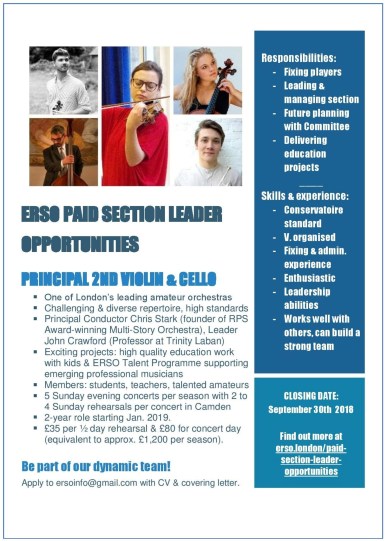 ERSO Soloist of the Year 2019
 ERSO
ERSO 