“Why the Strauss?” we asked our fabulous soloist Michael Stowe for our Principal Conductor premiere concert. After all, it’s known as one of the most demanding oboe concertos ever written!
He had a great answer: “I have chosen to perform the Strauss concerto as I feel it perfectly demonstrates what the oboe does best: playing beautiful, endless melodies. The concerto was written in 1945 towards the end of Strauss’s life during what is known as his ‘Indian Summer’ of music, where he composed numerous beautiful pieces of music including his Four Last Songs and the Metamorphosen for solo strings, which I feel collectively paint a picture of Strauss’s life as a composer.”
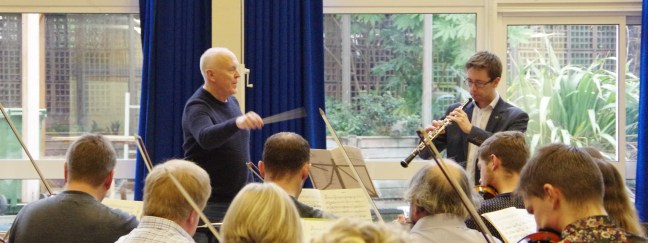
Michael at the Grand Final of ERSO Soloist of the Year 2018, with ERSO and Peter Stark
Did you know that Dvorak was a trainspotter? And that this was connected to the 7th Symphony?
Franz Josef Central Station
He spent hours at the Franz Josef railway station in Prague, talking to train drivers and noting down engine numbers.
Dvorak’s handwritten score for his 7th Symphony
The theme from his 7th Symphony came to him when he was at the station watching a train bringing anti-Habsburg sympathisers from Budapest to Prague for a festival at the National Theatre. Dvořák strongly identified himself with the rising tide of Bohemian nationalism and had been tracking the group’s progress with enthusiasm.
At the very bottom of the page of the score of the first movement, Dvořák’s handwritten note reads: “I got this theme when the festival train from Pest was arriving in the State Station in 1884.”
Did you know that ERSO was the first to give some famous faces the chance to play a concerto? Ernest Read wanted to give members of the ERSO the chance to play as soloists and the first player to get this chance (in 1931) was the young Evelyn Rothwell, who went on to become one of the UK’s most famous oboists.
Other famous firsts include Guy Johnstone who got his earliest solo opportunity when at 14 years old he performed the Lalo Cello Concerto with ERSO at the Royal Festival Hall. He went on to win BBC Young Musician of the Year and became a famous solo cellist and a Professor at the Royal Academy of Music. He’s been described as “an impeccable soloist” (Gramophone), whose “playing is searchingly beautiful and accurate” (BBC Music Magazine).
And did you know that the young 13 year old Jacqueline du Pre first performed the Elgar Cello Concerto with ERSO (known then as the London Senior Orchestra) back in December 1959?
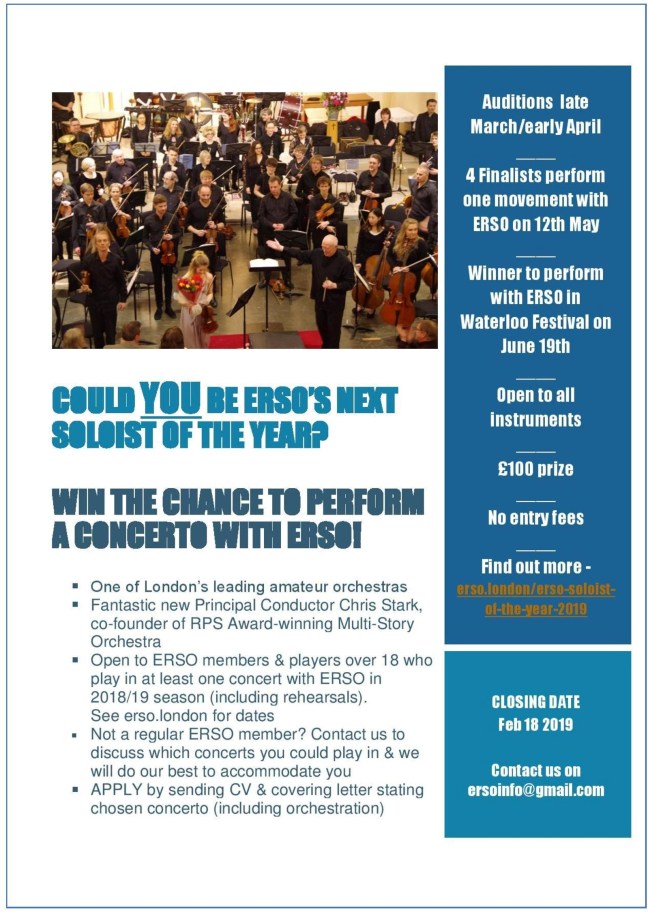
Ernest Read was so keen to give young players the chance to perform as soloists with ERSO. We’re proud to continue the tradition via our ERSO Soloist of the Year competition, open to regular ERSO members and musicians who play at least one concert (incl rehearsals) with us this season, and hope some of our contestants might follow in their footsteps!
So many famous and influential musicians got their early experience and training with ERSO. Here are just a few….
Did you know that James Galway was one of our famous former members before he became the Man with the Golden Flute!
James Galway
Jack Brymer
Another famous wind player who gained experience with ERSO was Jack Brymer, the legendary clarinettist who inspired a generation to take up the instrument. But he didn’t plan to be a professional musician and initially trained and worked as a PE teacher. His life was transformed when a report of his playing in ERSO reached Sir Thomas Beecham via Dennis Brain, another ERSO player, as Beecham was looking to fill the principal clarinet role at the RPO. Brymer thought it was a friend playing a trick when he got the call! Of course he got the job and started to make clarinet history.
Manoug Parikian
Manoug Parikian, the British concert violinist and admired teacher at the Royal Academy of Music .
He led several orchestras including the Liverpool Philharmonic and the Philharmonia Orchestra and championed contemporary composers, many of whom wrote works for him: including Thea Musgrave’s Colloquy and Gordon Crosse’s Violin Concerto No. 2. Benjamin Britten also composed a cadenza to Mozart’s Adagio for Violin and Orchestra for him and was assisted by Parikian when revising the solo part of his own violin concerto.
Cecil Aronowitz
Cecil Aronowitz, the British viola player who was a founding member of the Melos Ensemble, a leading chamber musician and teacher at the Royal College of Music and the Royal Northern College of Music. At ERSO he was a member of the second violins but after the war he switched to the viola.
Benjamin Britten wrote many viola parts with Aronowitz in mind, particularly in his chamber operas, and the chamber music in his War Requiem was written for the Melos Ensemble.
Francis Baines
Francis Baines, one of Britain’s most accomplished classical double-bass players. He was a member of the London Philharmonic, a professor at the Royal College of Music, and a great friend of Malcolm Arnold.
A colourful character, he was prone to keep his instrument in a left-luggage locker at Victoria Station because he had no room for it at home!
And finally, SIEGFRIED OF THE HORN, which is what Sir Thomas Beecham called Dennis Brain, the British virtuoso horn player who was largely credited for popularizing the horn as a solo classical instrument with the post-war British public. He produced what many still consider to be the definitive recordings of Mozart’s horn concerti.
Dennis Brain
We’re proud to say that during the 1937/38 season Dennis was the third horn at ERSO. He joined age 16, introduced by older brother Leonard (an oboist) with the words “He’s been playing the horn for only a couple of years. He can do things as well as Dad can already!” As Dad was Aubrey Brain, Principal Horn at the BBC Symphony Orchestra, this was a sign of the great things to come!
Did you start your orchestral playing in a youth orchestra?
So many of us had our first musical training in these amazing organisations, and we should be grateful to Ernest Read!
In 1926 he founded the London Junior Orchestra, one of the earliest earliest youth symphony orchestras which grew to have 11 affiliate youth orchestras throughout Great Britain and led to the founding of so many more!
And did you know that Ernest Read was a sprightly sixty-five when he started the first residential School Orchestra Course for children in 1944?
One attendee in the first two years was a young teacher named Ruth Railton – and she was inspired by the experience to start the National Youth Orchestra!
That’s what Sir Thomas Beecham called Dennis Brain, the British virtuoso horn player who was largely credited for popularizing the horn as a solo classical instrument with the post-war British public. He produced what many still consider to be the definitive recordings of Mozart’s horn concerti.
We’re proud to say that during the 1937/38 season Dennis was the third horn at ERSO. He joined age 16, introduced by older brother Leonard (an oboist) with the words “He’s been playing the horn for only a couple of years. He can do things as well as Dad can already!” As Dad was Aubrey Brain, Principal Horn at the BBC Symphony Orchestra, this was a sign of the great things to come!
Legendary clarinettist Jack Brymer inspired a generation to take up the instrument. But he didn’t plan to be a professional musician and initially trained and worked as a PE teacher.
His life was transformed when a report of his playing in ERSO reached Sir Thomas Beecham via Dennis Brain, another ERSO player, as Beecham was looking to fill the principal clarinet role at the RPO.
Brymer thought it was a friend playing a trick when he got the call! Of course he got the job and started to make clarinet history.
Well, you COULD learn the Strauss oboe concerto (though we hear its tricky).
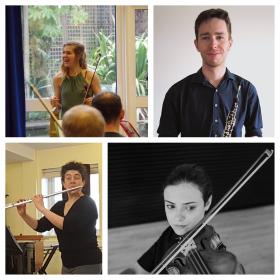
ORyou could enter our ERSO Soloist of the Year 2019 competition. Last year Michael was one of our four Finalists and they were all so amazing that they each have been given soloist opportunities with ERSO.
“So how do I do that?” we hear you say.
The competition is open to ERSO members or players who do at least one concert with us in the next season. Check it out and get in touch if you’re interested!
Well, you COULD learn the Strauss oboe concerto (though we hear its tricky).
ORyou could enter our ERSO Soloist of the Year 2019 competition. Last year Michael was one of our four Finalists and they were all so amazing that they each have been given soloist opportunities with ERSO.
“So how do I do that?” we hear you say.
The competition is open to ERSO members or players who do at least one concert with us in the next season. Check it out and get in touch if you’re interested!