Sunday’s “In Disguise” family concert saw ERSO saying a very fond farewell to our wonderful Principal 2nd Violin Tom Rowan-Young and Principal Cello Barbara Mohorko.
Tom and Barbara were part of the original team of ERSO string section leaders, along with former Deputy Leader Jaga Klimaszewska, and their contribution to ERSO has been massive – not only in terms of building and coaching our wonderful string sections but also in their energy, enthusiasm and ideas which they have contributed so freely.
We’re going to miss them so much and we wish them well in their next endeavours.
Yesterday at our “In Disguise” family concert there was no disguising the pride felt by the parents, friends and relatives of the Camden Training Orchestra children!
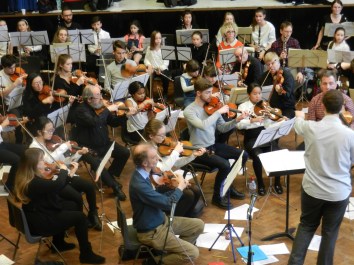
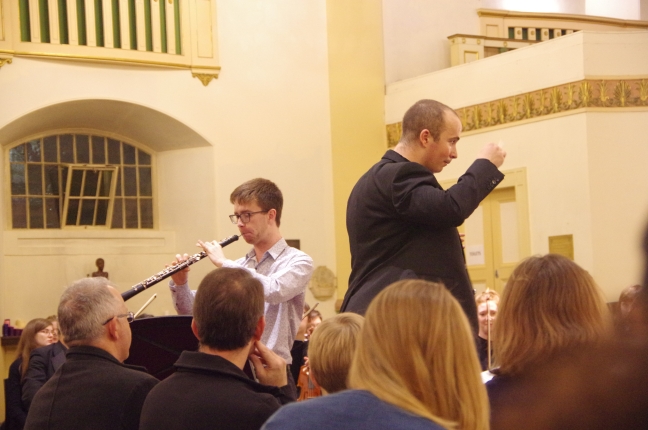
The Camden Training Orchestra with ERSO and conductor Chris Stark
Led expertly by our fabulous presenter Tim Keasley and conductor Christopher Stark, we explored a world of music where nothing was quite as it appeared.
The children joined the adult members of ERSO in a spirited performance of the Entry of the Gladiators – a tune usually associated with circus clowns – and a soulful rendition of Skyfall which featured talented young singer Naomi Marchbank, a 6th form pupil at Camden School for Girls. Their final piece was A Whole lot of Symphonies which were disguised as one piece. We also explored Britten’s modern interpretation of Tudor courtly dances and learnt about the perils of ice-cream and mistaken identity at grand Russian balls through the Masquerade Suite by Khachaturian!
A great time was had by all, with parents calling it a “rich and meaningful experience for the young players” and “amazing, informative and educational”. When the children were asked if there any ways we could improve the experience they said “NO” and
It’s been almost a year since we last worked with talented presenter Tim Keasley and we caught up with him for a quick chat….
How old were you when you started playing the oboe and why did you pick that instrument?
I started learning the oboe with I was 10 and picked it because you could have lessons for free through my county music service. There was a list of ‘endangered instruments’ you could choose from (most of which I’d never heard of) and picked ‘the oboe’ on a bit of a whim! I was a bit disappointed when I first opened the case…
What age were you when you decided that you would like to become a musician and what inspired this decision?
I’m not sure that I ever had a eureka moment as such – i just really love playing music with other people and didn’t want to stop! My first proper teacher was hugely inspirational and music just seemed to pour out her. She was so excited by how you could tell stories through music, something I still hold very close to my heart.
How did you get started as an animateur?
By accident! When I started at music college I got a bit twitchy spending so much time in a practice room. I started to take lots of optional classes, all sorts of things from yoga for musicians to how to write better programme notes. One of the classes was called ‘creative music leadership’ which sounded intriguing… I ended up being a supporting musician for loads of different projects and had an amazing time! I especially love writing songs with groups who don’t identify themselves as musicians and then cracking out a banger! I ended up doing a year as an Open Academy Fellow at the Royal Academy of Music and then as the Trainee Music Leader at Wigmore Hall. I’m now incredibly lucky to still be involved with various projects at Wigmore, including Singing with Friends (a choir for people living with dementia), Music for Life (a project in residential care homes), Family Days, presenting concerts, Chamber Tots and going into schools. And its really lovely to have been invited back to present with ERSO and Camden Training Orchestra
Do you prefer presenting or playing the oboe?
What a tricky question! I like them both in different ways… and I like doing a bit of both in the same concert! I think doing either successfully requires you to be ‘in the moment’ and think on your feet to keep things afloat which is really exciting.
What would be your dream musical job?
Something where I got to share my love of music by playing and talking about it! Maybe doing something like Tom Redmond’s work with the Halle or Sarah Willis and the Berlin Phil.
A re-creation of one of Tim’s finer moments!
What is the funniest or strangest thing that has happened to you when you’ve been presenting?
Last year, I was persuaded by Fiona (organisational Queen of ERSO) to dress up as a cow and run through the concert hall popping up in different places like bovine Where’s Wally to the soundtrack of Milhaud’s surrealist ballet Ox on the Roof. Anything for Art…
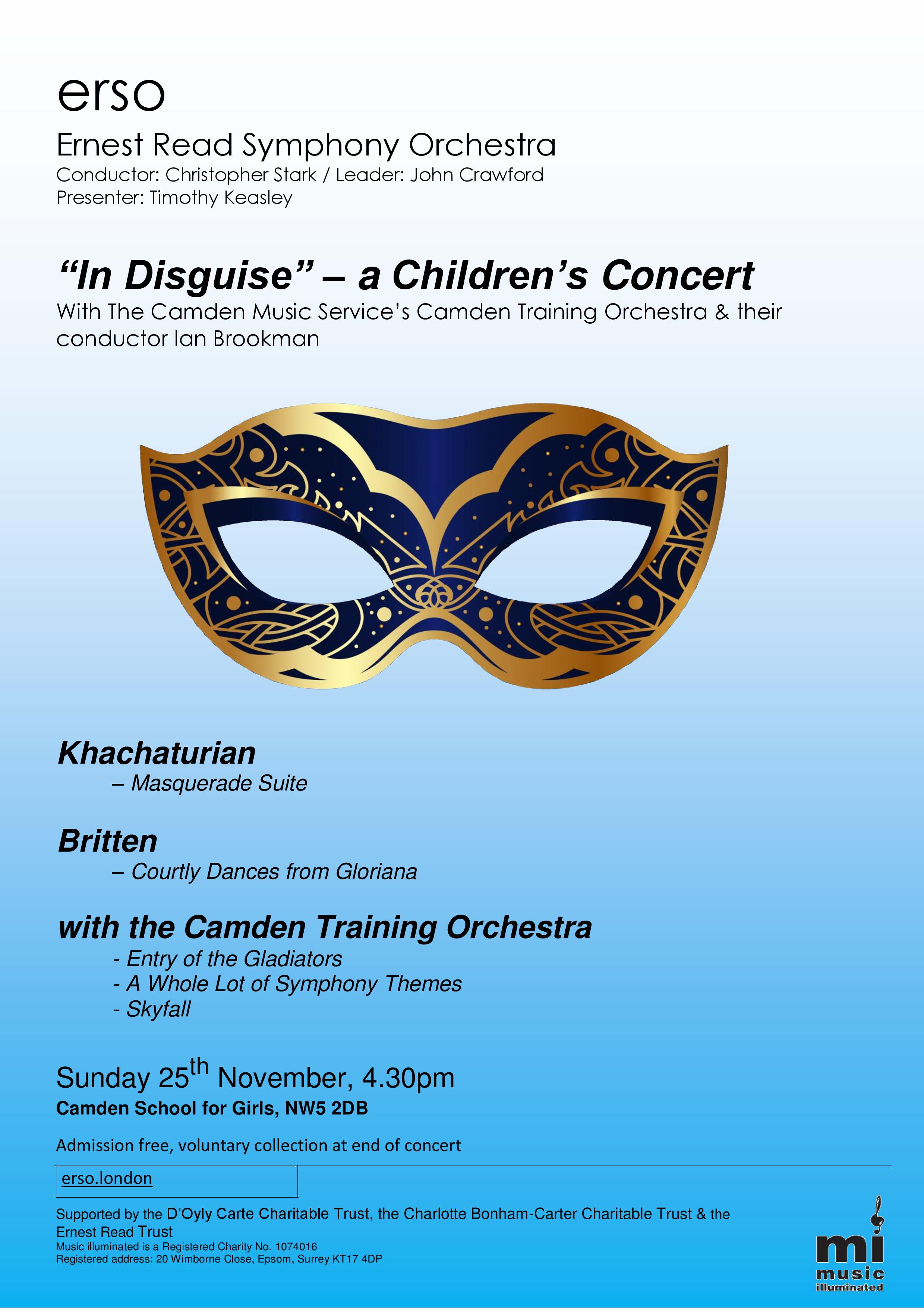
Come and share another afternoon of music and fun with ERSO, Tim and the children from the Camden Training Orchestra in our “In Disguise” Camden children’s concert
Ever wondered who wrote the music that’s traditionally associated with circus clowns?
It’s by Julius Fučík (1872 – 1916), a Czech composer and conductor of military bands. He was composed over 400 marches, polkas and waltzes. His “Entrance of the Gladiators” is one of the best known, sometimes under the title “Thunder and Blazes”, as one of the most popular theme tunes for circus clowns.
At ERSO we’re excited to be playing it with the young musicians from the Camden Music Service and their conductor Ian Brookman as part of our “In Disguise” – Camden children’s concert.
Come and join us for a fun afternoon of fabulous music!
It was written as incidental music for the play Masquerade by the Russian Romantic writer Lermontov, which is often compared to Othello. And it’s a sad story!
A scene from “Masquerade” play at the Alexandrinsky Theatre, St Petersburg in 1938. Source: Press photo
In 1830s St. Petersburg, aristocrat Arbenin and his wife Nina attend a masquerade ball. In a tragic case of mistaken identity, Arbenin convinces himself that his wife is romantically involved with Prince Zvezdich.
At the ball, Prince Zvezdich is flirting with a dissolute lady, a baroness who is a friend of Nina. But because of the masks no-one knows who she is. The mystery lady gives Zvezdich her bracelet as a memento – but it’s a bracelet that once belonged to Nina. Arbenin recognises it and concludes that his wife is the shady lady behind the mask and is cheating on him.
Arbenin kills his wife but then learns that she was in fact innocent. Realising that he has murdered his beloved wife in error, he becomes insane.
The play was banned in Lermontov’s time by censors and is rarely performed, but the suite it inspired became one of Khachaturian’s best known works.
Did you know that the opera Gloriana was commissioned by Covent Garden as a part of the celebrations for Queen, Elizabeth II’s the coronation?
It was the composer’s eighth opera with libretto based on Lytton Strachey’s Elizabeth and Essex and depicted Queen Elizabeth I as a woman torn between her sense of duty as the monarch and her love for Essex.
The Queen attended the first performance at Covent Garden six days after the coronation but was said to have been unimpressed by the opera. And she wasn’t alone. Criticism was aimed at the way that the opera highlighted the Queen’s frailties, her personal relationship with the Earl of Essex, and the intrigues and jealousies at Court. It was thought that the persona of Queen Elizabeth I of England should have been portrayed in a more regal way. Britten was also criticised for choosing to close the opera with the spoken word, rather than musically.
Gloriana at the Royal Opera House, London. Photograph: Tristram Kenton for the Guardian.
Britten felt “kicked around” by the general lack of enthusiasm for Gloriana and, in contrast to his other operas, there has since been relatively few productions of this opera.
The Courtly Dances appear in the third scene of Act II and were subsequently made into a Suite. Britten’s score mixes the sounds and manners of Tudor England – from lute songs to courtly dances – with the composer’s own distinctive style.
ERSO’s first concert with new Principal Conductor Christopher Stark was an amazing start to our new partnership and promises great things for future concerts and seasons! Our appreciative audience clearly enjoyed the spirited performance of Der Freischutz and Dvorak’s dramatic 7th Symphony.
We were delighted to be joined by hugely talented young soloist Michael Stowe, whose beautiful and lyrical performance of the Strauss oboe concerto was wonderfully accomplished.
If you missed it, put the next concert date in your diary now – our next St John’s concert is our Russian Masterworks concerton 17th February is our and includes Prokofiev’s Cinderella Suite No. 1 and Shostakovich’s 6th Symphony.
How do such mundane things as trains and potatoes link to Dvorak’s stirring 7th Symphony?
Franz Josef Central Station in Prague
Dvorak was a trainspotter and spent hours at the railway station in Prague, talking to train drivers and noting down engine numbers.
The theme from his 7th Symphony came to him when he was at the station watching a train bringing anti-Habsburg sympathisers from Budapest to Prague for a festival at the National Theatre. Dvořák strongly identified himself with the rising tide of Bohemian nationalism and had been tracking the group’s progress with enthusiasm.
At the very bottom of the page of the score of the first movement, Dvořák’s handwritten note reads: “I got this theme when the festival train from Pest was arriving in the State Station in 1884.”
Simrock, Dvořák’s publisher
When Dvořák’s publisher Simrock failed to send him an advance for the Symphony, the composer complained that he had endured a bad potato harvest and needed some money upfront.
Its that time again – we’re gearing up for our annual Camden children’s concert in November. And we were thinking about why its such a key part of our year.
ERSO’s LONG history of children’s concerts
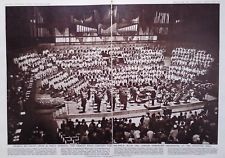
An Ernest Read Children’s Concert in the Festival Hall in 1962
ERSO was founded in 1931 by Ernest Read, who was passionate about spreading music as widely as possible, and was famous for his Ernest Read Concerts for Children which began in 1945 at the Royal Festival Hall.
We are proud to continue Ernest Read’s legacy with our November and March children’s concerts in Camden.
The difference music makes to kids
Young Camden Training Orchestra musician enjoying rehearsal with ERSO in 2017
Learning an instrument and being engaged with social music-making brings many well documented educational and social benefits to children, especially to those from disadvantaged backgrounds, including: improved academic progress; memory; social skills; motivation and discipline. This is really relevant in Camden where 36% of children live in poverty, rising to 42% in the poorest ward, St Pancras & Somers Town.
The Camden Music Service say that children dropping out of music-making is one of the biggest issues that they face.
ERSO and Camden
Our Camden concerts in November and March offer Camden children the opportunity to perform in concerts with ERSO, helping to inspire and encourage them with music. We work closely with the Camden Music Service and the Camden School for Girls.
ERSO and the Camden Training Orchestra in rehearsal
In November we’ll be working with the children from the Camden Music Service’s Camden Training Orchestra. ERSO will be playing some fantastic music and we’ll be playing three pieces with the children who will be sitting within the orchestra for the whole concert. Each child will sit with an adult who will be able to help and advise them on the music so that they can relax and enjoy the rehearsal and concert.
We’ve had great feedback to say how inspiring the kids find sitting amongst the adult musicians as it lets them hear what their instruments could sound like with practice and experience what it would be like to play in a more advanced ensemble.
“I am writing to you today to let you know how exciting, beautiful and inspiring last night’s concert was. My daughter who plays the violin was so happy to be sitting with ERSO players. A wonderful and memorable experience for my daughter and myself!”
How did a young American soldier, John de Lancie, end up inspiring Strauss to write his famous oboe concerto in the period known as his “Indian Summer”?
John de Lancie
At the end of the 2nd World war, in April 1945, the U.S. Army arrived at the Bavarian town of Garmisch. Their first job was to commandeer houses and locals were given minutes to pack and leave. One elderly man refused to go, saying “I am Richard Strauss, composer of Rosenkavalier and Salomé.” Luckily the most senior officer knew who Strauss was and ordered his men to find other houses, and Strauss his invited them in for dinner.
The elderly Strauss at his home
Strauss received many visits from the US soldiers, including a 24-year old intelligence officer John de Lancie who, in his civilian life was principal oboist with the Pittsburgh Orchestra. During his many visits they had long conversations in French about music. Familiar with Strauss’s beautiful oboe parts in his orchestral works, de Lancie asked the composer if he had ever thought of composing an oboe concerto, to which Strauss simply said “No”.
A few weeks later, however, Strauss began to sketch some ideas, and a short score was written out by 14 September. By the end of the following month, the composer had completed the finest concerto for oboe written in the 20th century.
Back home in the United States, de Lancie was astonished to discover that Strauss had published an oboe concerto and that the autograph of the score bore the inscription, “Oboe Concerto – 1945 – suggested by an American soldier.” Strauss also gave the rights to the U.S. premiere of the piece to de Lancie but the Philadelphia Orchestra overrode Strauss’s wishes on the grounds that de Lancie was not the principal oboe.
John de Lancie went on to be one of the most accomplished oboe players of the post-war era, serving as the principal oboist for the Philadelphia Orchestra for 30 years, as well as becoming a well known teacher. It was only after his retirement that he finally performed and recorded the work the idea for which he had planted in the mind of the ageing Richard Strauss, contributing to the composer’s ‘Indian summer’ at the end of a long and distinguished composing career.






 It’s by Julius Fučík (1872 – 1916), a Czech composer and conductor of military bands. He was composed over 400 marches, polkas and waltzes. His “Entrance of the Gladiators” is one of the best known, sometimes under the title “Thunder and Blazes”, as one of the most popular theme tunes for circus clowns.


 ERSO’s first concert with new Principal Conductor