Calling composers!!

Would you like to win the chance to have your composition performed by the Ernest Read Symphony Orchestra, one of London’s leading and longest established amateur orchestras, conducted by renowned young conductor Christopher Stark?

We are looking for an inspiring, contemporary classical Fanfare for full symphony orchestra which celebrates ERSO’s 90th Birthday and the huge contribution to music made by our founder, Ernest Read.

The competition is open to composers who are aged 16  – 30 years old on January 15th, 2020 and who are UK residents.

emma-ruth richards pic
Acclaimed composer Emma-Ruth Richards

Up to 10 composers will be invited to workshop their Fanfare with ERSO.  These composers will benefit from heairng their piece played by a full symphony orchestra and from feedback given by our conductor Christopher Stark, leader John Crawford (a Professor at Trinity Laban) and renowned British composer Emma-Ruth Richards.  The workshop will be recorded, and the composers will be given a recording of ERSO playing their Fanfare to use as part of their portfolio.

The composer of the winning Fanfare will be awarded a prize of £250.  They will also receive a commission of £1,000 to create a piece for soloist and orchestra for the winner of the ERSO Soloist of the Year 2020 competition.

The winning Fanfare and the soloist piece be central pieces at ERSO’s 90th Birthday Gala concert to held in the prestigious Duke’s Hall at the Royal Academy of Music in Spring 2021.  The concert will be recorded and the winner will be given copies of the recording of both pieces.

Entry to the competition is free and applications close on 15th January 2020

To find out more about the competition go to: ERSO emerging composers’ competition: “A Fanfare for Ernest Read”

Four weeks to go – we can’t wait!

In just four weeks we’ll be kicking off our new season at ERSO and we’re raring to go as we’ve got some fabulous programmes planned!

And as if that wasn’t enough, we have our ERSO Soloist of the Year 2020 competition.  Players who take part in at least one concert this season (including rehearsals) are eligible to enter.  The prize is to be our June soloist AND to have a solo piece written for you by the winner of our ERSO emerging composers competition (watch this space for more information very soon!)

We’re a friendly orchestra playing to a very high standard under inspiring Principal Conductor Christopher Stark.  We are always delighted to hear from experienced players, especially strings.

Interested?  Then get in touch on ersoinfo@gmail.com


2019-20 season one pager v4-page-001

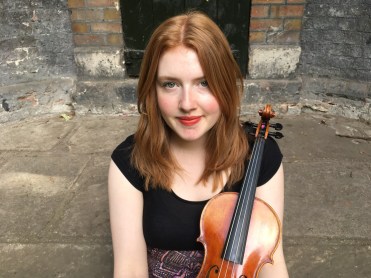
Meet October’s soloist, Bella Fleming

We caught up with Finalist Bella who will be playing the Mozart 2nd Violin Concerto in ERSO’s Mozart & Mendelssohn.

What is your main occupation at the moment?

I am currently studying for a Masters at Guildhall School of Music and Drama on the LSO Orchestral Artistry course.

What made you choose to play your instrument and how old were you when you started?

I sang and learnt piano with my mum from an early age. I was lucky to have the opportunity to start violin aged seven at primary school through Redbridge Music Service.

What made you choose the concerto that your will be playing?

My admiration for Mozart has increased through performing in his operas. I chose the second violin concerto because I enjoy its shifting moods from playful in the first movement; through consolation in the second, finishing with a joyful dance in the third.

What do you feel you would gain from the experience of playing this concerto with ERSO and Chris Stark?

It is a wonderful opportunity to perform this less frequently heard concerto in its entirety with ERSO and Chris Stark.

“First rate players of tomorrow”

With out hisorical hat on, we found this article from The Musical Times in 1938.  Although ERSO had only been in existence for a few years, it was already recognised as being largely made up of the “first rate orchestral players of tomorrow” and providing opportunities for young professionals as they bridged the gap between their training and a career. Not to mention being at the forefront of concerts for children….

We are so proud that what we do today, when ERSO is almost 90 years old, remains true to Ernest Read’s original vision.

composite players fo future and pic From The Musical Time in Jan 1938-page-001

Early chances from ERSO

tamsin little etc
The Musical Times listings page from Nov. 1979

Ernest Read was always keen to give chances for talented young performers to play as soloists early in their careers and we came across this concert in an old issue of the Musical Times in 1979.

Tasmin Little // Chandos // London 28 June 2016
Tasmin Little

Back then the Ernest Read Children’s Concerts took place at the Festival Hall with two concerts on the same day to allow maximum audience to attend.  The concerts often featured talented young players and this was no exception – amongst the four featured string players from the Yehudi Menuhin School was 14 year old Tasmin Little who went on to become widely acclaimed as a concerto soloist, chamber musician and recording artist.  She was joined by 16 year old Clare McFarlane who went on to win the string final of the BBC “Young Musician of the Year” competition in 1980 together with Elizabeth Layton and Caroline Henbest, all of whom went on to succesful musical careers.


Inspiring oboes – part 2

janet craxtonAnother former ERSO member (back when we were called the London Senior Orchestra) was Janet Craxton.  She was an influential oboist, teacher and champion of new music and played with ERSO to gain orchestral experience prior to entering the Paris Conservatoire in 1948.  When she returned was at immediately engaged as principal oboist of the Hallé Orchestra from 1949 to 1952.  Janet went on to become principal oboe in the London Mozart Players from 1952 to 1954, the BBC Symphony Orchestra from 1954 to 1963, the London Sinfonietta from 1969 to 1981, and the orchestra of the Royal Opera House from 1979 to 1981. She was appointed oboe professor at the Royal Academy of Music in 1958.

She was much in demand as a soloist, and gave world premières of works by Ralph Vaughan Williams, Lennox Berkeley, Alan Rawsthorne, Elisabeth Lutyens, Elizabeth Maconchy, Richard Stoker and Priaulx Rainier. In 1958, she was co-dedicatee and original performer with the tenor Wilfred Brown of Ralph Vaughan Williams’ song cycle Ten Blake Songs.

Inspiring oboes part 1

evelyn rothwellErnest Read, the founder of the Ernest Read Symphony Orchestra, was extremely keen to give the aspiring professional musicians who played in the orchestra the valuable opportunity to play as soloists. The first player to get this chance in 1931 was the young Evelyn Rothwell (also known as Evelyn Barbirolli), who went on to become one of the UK’s most famous oboists.

We’re proud to continue the tradition via our ERSO Soloist of the Year competition, open to regular ERSO members and musicians who play at least one concert (incl rehearsals) with us this season. https://erso.london/erso-soloist-of-the-year-2020/

Who knows if some of this year’s contestants might follow in Evelyn’s famous footsteps?!

Another famous face in ERSO’s history….

jack brymerLegendary clarinetist Jack Brymer inspired a generation to take up the instrument.  But he didn’t plan to be a professional musician and initially trained and worked as a PE teacher!

Brymer was ERSO’s principal clarinet in the late 1930’s and said that Ernest Read was “one of the most helpful friends I ever had, just as he had proved to be to hundreds of other young players to whom he gave, free of charge, the most valuable training.”

His life was transformed when a report of his playing in ERSO reached Sir Thomas Beecham via Dennis Brain, another ERSO player, as Beecham was looking to fill the principal clarinet role at the RPO.

Brymer thought it was a friend playing a trick when he got the call! Of course he got the job and started to make clarinet history.

Siegfried of the horn!

Carrying on our trip down ERSO’s memory lane…..

Siegfried of the horn is what Sir Thomas Beecham called Dennis Brain, the British virtuoso horn player who was largely credited for popularizing the horn as a solo classical instrument with the post-war British public. He produced what many still consider to be the definitive recordings of Mozart’s horn concerti.

We’re proud to say that during the 1937/38 season Dennis was the third horn at ERSO.  He joined age 16, introduced by older brother Leonard (an oboist) with the words “He’s been playing the horn for only a couple of years.  He can do things as well as Dad can already!”  As Dad was Aubrey Brain, Principal Horn at the BBC Symphony Orchestra, this was a sign of the great things to come!