Harsh

The initial reaction to La Mer wasn’t positive which is hard to imagine nowadays and it’s  premiere perplexed its audience and the critics, who were not kind in their reviews: “crafty“, “incomprehensible and lacking in grandeur“, “sharp sonority and often unpleasant“…

Luckily today we all recognise what a work of genius it really is.

To find out more, here’s a sneak peak at the programme notes for our Brahms and Debussy concert.

La Mer, Three Symphonic Sketches

Claude Debussy was born in Saint-Germain-en-Laye, France, to an impoverished, and not at all musical, family. However, his obvious gift at the piano won him a place at the age of ten to France’s leading music college, the Conservatoire de Paris. There, his instructors disapproved of his delight in ‘forbidden’ harmonies while his fellow students found his innovative compositions and mesmerizing piano improvisations strange. Despite this, at age 22, he won France’s most prestigious musical award, the Prix de Rome. The prize included a four-year residence in Rome to further his musical studies. However, he found life there irksome and left after only two years.

Back in Paris he led a bohemian life, enjoying the café society but struggling financially while pursuing his experimental approach to composition. It was not until 1902, aged nearly 40, that Debussy achieved international fame with his only opera, Pelléas et Mélisande.

Debussy died in Paris of colon cancer when he was just 55 years old. Often described as the first Impressionist composer, he disliked the term. In his words, “I love music passionately. And because I love it, I try to free it from barren traditions that stifle it. It is a free art gushing forth, an open-air art boundless as the elements, the wind, the sky, the sea. It must never be shut in and become an academic art.”

La Mer is the closest piece to a symphony that Debussy wrote. Its original reception was rather mixed – during rehearsals the violinists tied handkerchiefs to the tips of their bows in protest. But it is hard to know whether the hostile reaction was to the novel and challenging music or to the scandal that had preceded it. While his wife of four years, fashion model Lily Texier, was away visiting her father, Debussy had secretly holidayed with Emma Bardac, wife of a Parisian banker and a gifted singer. When he subsequently wrote to his wife informing her that the marriage was over, Lily shot herself. Miraculously she survived, with the bullet remaining lodged in a vertebra under her left breast for the rest of her life. In the ensuing public outrage, Emma’s family disowned her and they both lost a good many friends. Debussy and Emma, now pregnant, escaped to England, where La Mer was completed in 1905.

“You may not know that I was destined for a sailor’s life and that it was only quite by chance that fate led me in another direction. But I have always held a passionate love for the sea,” Debussy wrote. Although his father was a sailor, the composer was hardly a seafarer. His personal knowledge of the sea appears to have been derived from three Channel crossings, childhood summers at Cannes and an unfortunate storm-tossed voyage in a fishing boat along the coast of Brittany. By his own admission he preferred to draw his inspiration from the seascapes available in painting and literature.  On the cover of the manuscript he placed the drawing titled “Hollow of the Wave off Kanagawa” by Katsushika Hokusai.

The first movement, begins very quietly, with slow, mysterious murmuring as if peering into the very depths of the dark, mysterious sea. As the sea awakens, the motion quickens. We hear a leisurely call from the muted horns. A mosaic of melodic fragments develops into an impressive climax. After subsiding, a new melodic idea, a noble chorale-like passage, appears and slowly grows into a majestic picture of the sea under the blazing noonday sun.

The next movement is lighter and faster, full of sparkle and animation. The music conjures up pictures of rocking waves, unexpected shifts of current, the iridescent glint of sunlight on the surface of the water and the mysterious depths beneath.

The final seascape opens restless, grey and stormy, the music suggesting the mighty surging and swelling of the water. Melodic fragments from the first movement return. The activity subsides, and out of the mists comes a haunting, distant call high in the woodwinds. The music again gathers energy. Finally, we hear once more the chorale from the first sketch, and La Mer concludes with the sea in stormy triumph.

What a year!

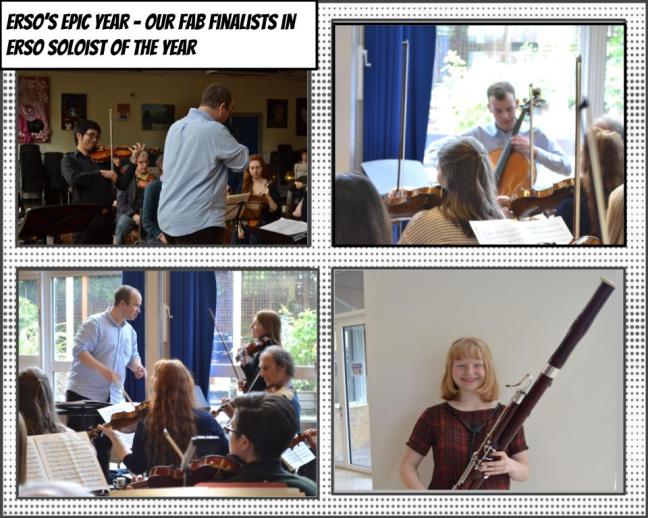
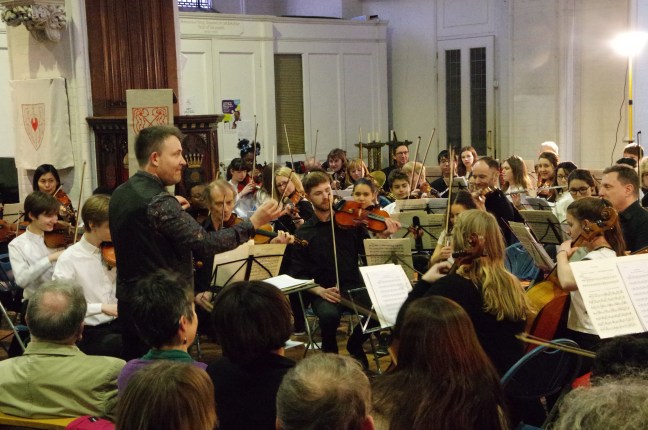
comic strip finalistsAt ERSO we had such fun in 2019 – and our Soloist of the Year Final was one of the highlights!  We were totally wowed by our four fabulous finalists as they shared an afternoon rehearsal with ERSO and conductor Christopher Stark
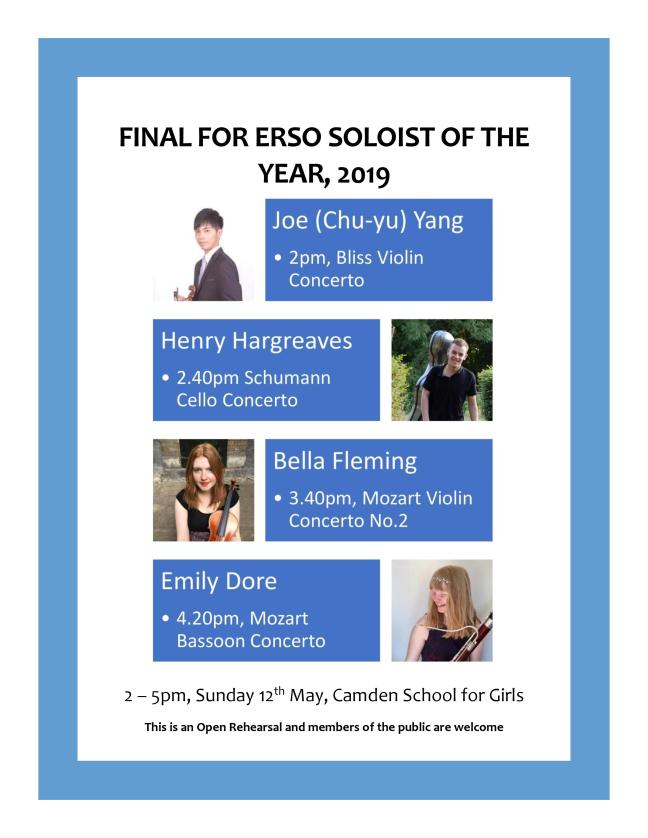
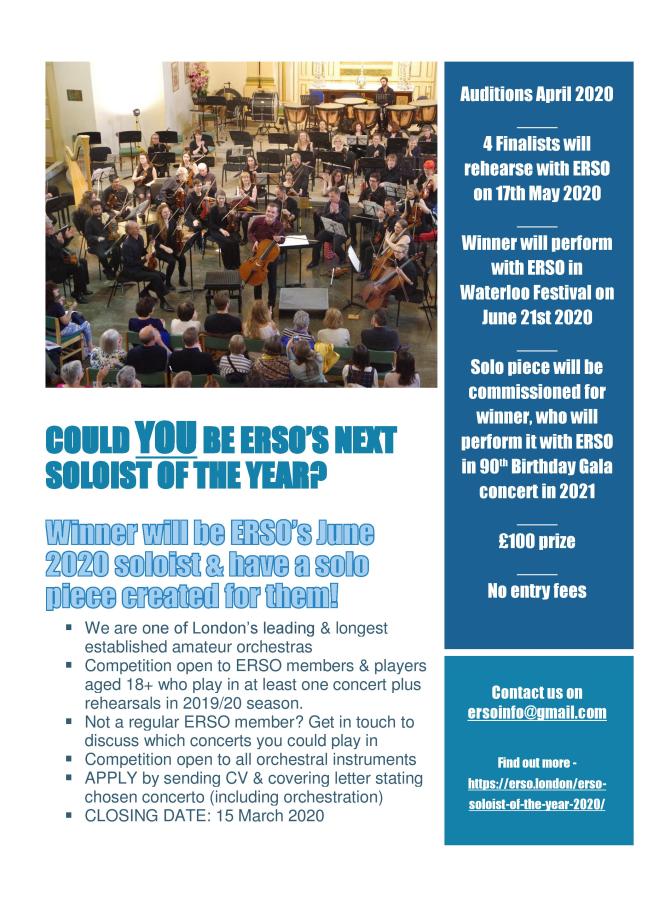
Fancy following in their footsteps?  This year has an EVEN bigger prize so check it out: ERSO Soloist of the Year 2020

final poster ERSO SOLOIST OF THE YEAR-page-001

ERSO’s got Talent!!

ernest read at queenswood
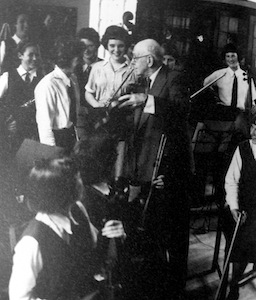
Ernest Read with young musicians at Queenswood School

ERSO was founded in 1931 by Ernest Read,  a celebrated pioneer in the development of music education and youth orchestras during the first half of the 20th century.

Our work with children and the ERSO Talent Programme are at the heart of what we do and follow directly from Ernest Read’s legacy.

The ERSO Talent Programme was created to bring together all of ERSO’s work with emerging professional musicians.  We’re so thrilled to work with talented young musicians at the start of their careers and are excited about our 2020 annual ERSO Soloist of the Year competition and ERSO emerging composers’ competition.


Calling young composers!

Would you like to have two of your pieces performed and recorded here by the Ernest Read Symphony Orchestra?

DUkes hall

The Duke’s Hall, Royal Academy of Music

emma-ruth richards pic
Emma-Ruth Richards

And be advised by acclaimed British composer Emma-Ruth Richards?

Composers aged 16  – 30 years old who are UK based are invited to submit a contemporary classical Fanfare for full symphony orchestra. 

The composer of the winning Fanfare will be awarded a prize of £250.  They will also receive a commission of £1,000 to create a piece for soloist and orchestra for the winner of the ERSO Soloist of the Year 2020 competition.

The winning Fanfare and the soloist piece be central pieces at ERSO’s 90th Birthday Gala concert on 28 February 2021.  The concert will be recorded and the winner will be given copies of the recording of both pieces.

Entry to the competition is free and applications close on 15th January 2020

To find out more about the competition go to: ERSO emerging composers’ competition: “A Fanfare for Ernest Read”

We are very grateful to the Ernest Read Trust and the RVW Trust for their generous support for this competition for emerging composers.RVWT PNG BLACK logo - SEP 2019.png

Violinists – fancy your chances?

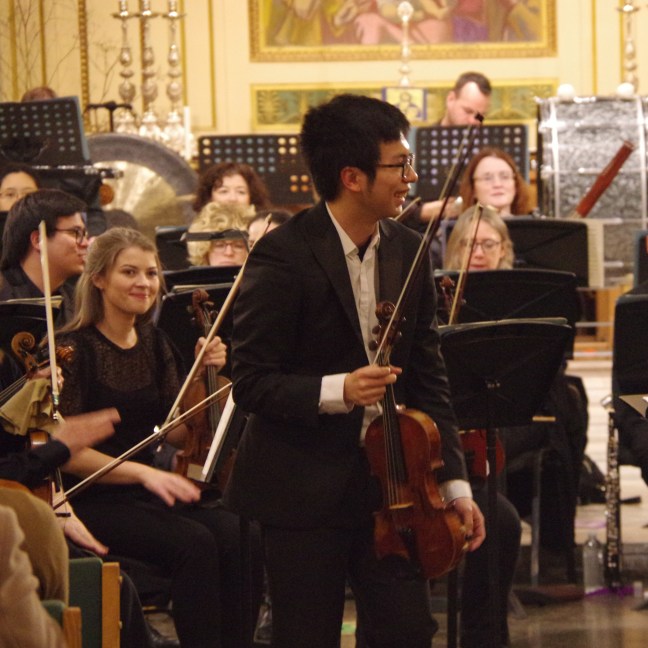
joe 5We’re so excited to work with hugely talented young music student Joe (Chu-Yu) Yang in our Brahms and Debussy concert in Feb 2020.   We met Joe in the 2019 ERSO Soloist of the Year competition and were hugely impressed by his performance as a Finalist.

If you are an ambitious soloist like Joe check out our ERSO Soloist of the Year 2020.   The winner will be our June soloist AND have a solo piece commissioned for them by the winner of our composers’ competition.   To be eligible you’ll need to take part in our Feb or March concerts – see dates: https://erso.london/members/current-detailed-concert-schedule/

As Joe’s story proves, the Finalists have a very good chance of being engaged as soloists in other concerts too.  And of the 8 Finalists from 2018 and 2019 HALF of the musicians were violinists!

We can’t wait …

At ERSO we’re excited like a child before Christmas – we can’t wait to review all of the amazing submissions for our ERSO emerging composers’ competition

Did you know that it’s not such a new idea for ERSO to be getting involved with composers?  John Rutter’s Partita for Orchestra (his first orchestral work!) was commissioned by the Ernest Read Music Association to celebrate the 50th anniversary concert of the London Junior Orchestra (later known as the Ernest Read Youth Orchestra). Rutter dedicated his work to Ernest’s wife Helen.

April 1976 saw the first performance at the 50th anniversary concert at the Festival Hall.  The concert was attended by royalty  – Princess Alexandra (the Queen’s cousin and ERMA’s patron) was present!

Is this one of your Christmas wishes?

christmas wish list template 01-page-001 (3)If the answer is yes, then good news!  Our ERSO Soloist of the Year 2020 competition could make your wish come true!

We have some spots left in upper strings and double basses for our Brahms and Debussy.

Anyone who takes part in this project (including rehearsals) will be eligible to enter and potentially win the prize of being our soloist in the June concert, as well as having a solo piece commissioned from the winner of our emerging composers’ competition.

This solo piece will be premiered by the winning soloist in ERSO’s 90th Birthday concert at the Duke’s Hall in February 2021.

Interested?  Get in touch on ersoinfo@gmail.com

Go, go, go, Joe!

joe 5
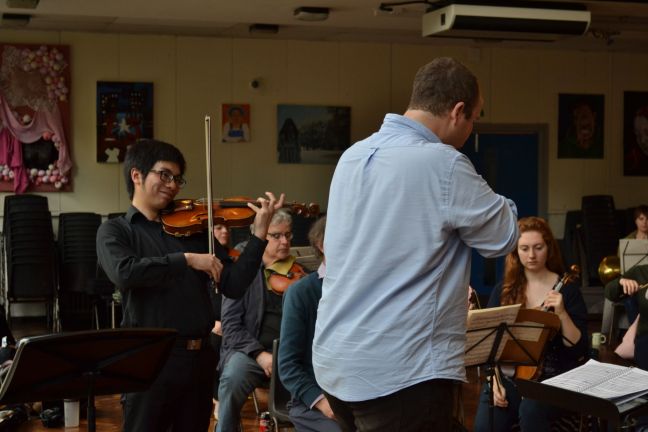
Joe rehearsing with ERSO in the 2019 final of our ERSO Soloist of the Year competition

At ERSO we are SO excited to be working with hugely talented young soloist Joe (Chu Yu) Yang in our Brahms and Debussy concert in Feb 2020.  He’ll be delighting our audience with The Lark Ascending by Vaughan-Williams.


We met Joe when he applied for the 2019 ERSO Soloist of the Year competition and were hugely impressed by his performance in the final.

If you are an ambitious soloist and feeling envious of Joe, then check out our ERSO Soloist of the Year 2020 comoetition – the winner will be our June soloist AND have a solo piece commissioned for them by the winner of our composers’ competition.  And Joe’ss story proves, the finalists have a very good chance of being engaged as soloists in other concerts too.ERSO Soloist of the Year 2020-page-001 (3)

It’s time for Tom!

At ERSO we are so pleased to welcome our great friend Tom Hammond back as our guest conductor for our November “Firebird” choral concert.

It is always such a pleasure to work with Tom and we know that we’ll create a really special concert together with the talented young musicians at the Camden School for Girls.

IMGP4655
ERSO and Tom in our May 2019 Nordic concert
tom full orchestra concert
Tom and ERSO working with children from the Camden Sinfonia in March 2018

Bellissima!

IMGP1755
Bella performing with ERSO

That’s certainly what our appreciative audience thought at last night’s Mozart and Mendelssohn concert!

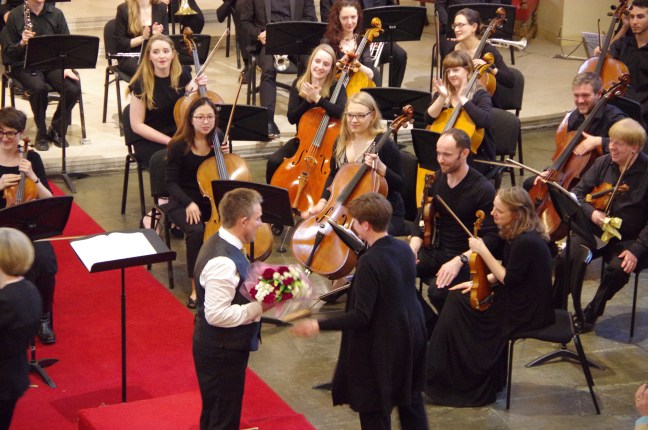
They clearly loved soloist Isabella Fleming’s beautifully sensitive and accomplished performance of Mozart’s 2nd Violin concerto.  Bella was a Finalist in the 2019 ERSO Soloist of the Year competition and we were so impressed by her performance in the Final that we just had to ask her to be our soloist.

IMGP1801
A well deserved hug from leader John Crawford

The evening commenced with the striking Chavez arrangement of Buxtehude’s Chaconne and concluded with a stirring performance of Mendelssohn’s Reformation Symphony.

We can’t wait to get started on rehearsals for the next concert which includes Stravinsky’s Firebird Suite.

ERSO and CGS concert flyer nov